Building a bitcoin balance sheet with Scott Ellam
29th October, 2026
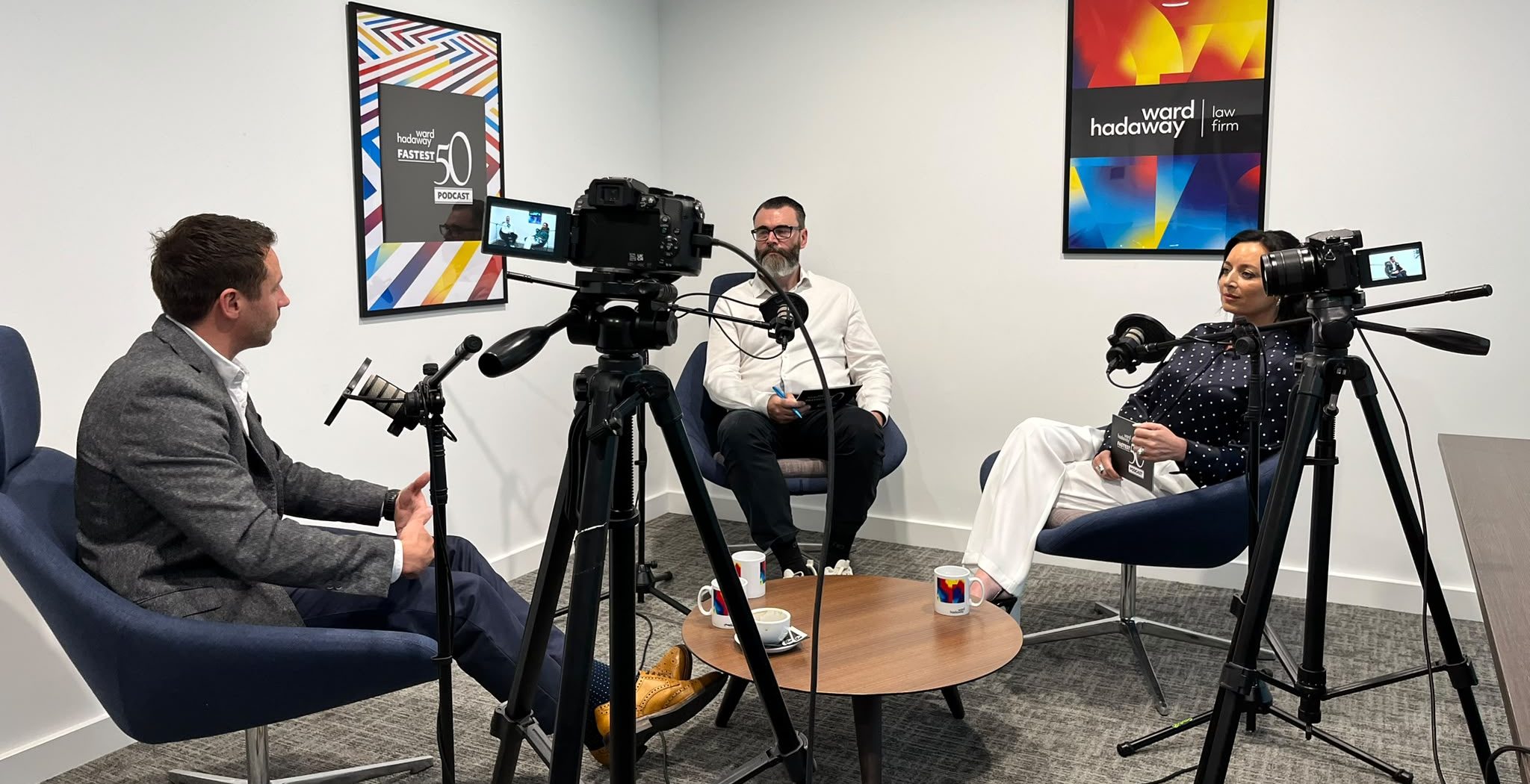
Welcome to the Ward Hadaway Fastest 50 Podcast, where we sit down with entrepreneurs and business leaders who are rewriting the rules of growth in the UK and beyond.

Scott Ellam, founder and CEO, Connecting Excellence Group (XCE)
In this episode, Alistair McDonald and co-host Emma Digby are joined by Scott Ellam, founder and CEO of Connecting Excellence Group (XCE), a UK listed international executive recruitment group with an integrated Bitcoin treasury. Scott founded the group’s flagship business, Spencer Riley, in 2014 with main objective of building the best place to work as a recruitment consultant. He explains how Bitcoin works and why he holds it as a long-term reserve asset and shares how Spencer Riley grew into an international firm generating over 70% of its revenue abroad. He talks openly about taking the business public and how XCE’s acquisition model offers a route to exit for owner managed recruitment firms that private equity tends to overlook.
You’ll hear practical insights on:
- How Bitcoin works and why Scott holds it on the balance sheet as a long-term reserve asset
- Why setting out to build the best place to work has shaped the business for over a decade
- Why you need a reason rooted in your mission to take your company public
- Managing the pace of the US market compared to the UK market
- Red flags to look out for when preparing your business for acquisitions
- How a listed group can offer an exit to owner managed businesses that private equity overlooks
Listen on Apple Podcasts, Spotify or YouTube


Fastest 50 is our annual celebration of the fastest growing businesses across the North of England. We are passionate about recognising and inspiring growth, which is why we launched the Fastest 50 Podcast – to hear candid insights from those leading the way in the UK business landscape.
Scott 0:00
There’s no CEO, there’s no marketing team, there’s nobody accountable for Bitcoin.
Scott 0:05
It is just software.
Scott 0:07
And there is a risk to being publicly associated with a bearer asset, a real personal risk.
Scott 0:12
The difference between serious inflation and hyperinflation is literally just panic.
Scott 0:20
We’re ignoring it a little bit because everybody’s in the same boat.
Scott 0:23
Nobody prepares you for the intensity of the birth of your first child, but nobody prepares you for the intensity of a first IPO either.
Scott 0:35
This could be the first time there’s a traditional business that grows as a direct result of a Bitcoin balance sheet.
Alistair 0:52
Hello and welcome to the Fastest 50 podcast.
Alistair 0:55
I’m Alistair MacDonald, Business Development Director at Ward Hardaway.
Emma 0:59
And I’m Emma Digby, Executive Partner of the Leeds office of Ward Hadaway, your co-host for this series.
Alistair 1:05
Today we are joined by Scott Ellam.
Alistair 1:07
Scott is the Founder and Chief Executive of Connecting Excellence Group PLC or more commonly known as XCE.
Alistair 1:15
A UK listed international, executive recruitment group with an integrated Bitcoin treasury.
Alistair 1:21
He founded the flagship business, Spencer Riley in 2014, now generating over 70% of its revenue abroad.
Alistair 1:29
XCE combines profitable recruitment businesses with Bitcoin as a long term reserve asset, using its treasury to support acquisitions, attract talent and fund growth.
Alistair 1:40
Scott, welcome to the Fastest 50 podcast.
Scott 1:43
Thanks for having me, Alistair, Emma.
Emma 1:44
Great to see you.
Emma 1:47
Let’s start with Bitcoin. Please can you explain to our listeners how Bitcoin works, how it’s recognised by banks and lending facilities? What’s it all about?
Scott 1:55
It’s the first time we’ve had a digital monetary asset that’s been purposely engineered.
Scott 2:03
So it’s an engineered money that’s digital.
Scott 2:05
And it’s the first time, and this statement might sound outlandish, but people quite often don’t really grasp the importance and how this will change the dynamics of money over the next 100, 200, 500 years.
Scott 2:19
It’s the first time in human history we have ever had a mathematically finite scarce asset.
Scott 2:27
There will only ever be 21 million bitcoins.
Scott 2:32
It’s the first time we’ve ever had an asset that I can transfer from me to you, Emma, without any third party permission.
Scott 2:41
But I can also transfer it to you if you’re sat in Australia. Or if we go more extreme, if you were sat in a war zone, you could transfer it to me to get your capital out of the country without any third-party permission.
Scott 2:55
And it’s the first time you can verify that that transaction has happened, and finite settlement has happened without third party trust.
Scott 3:03
There is a public ledger that is on hundreds of thousands of, let’s call them computers, nodes around the world and in space.
Scott 3:12
So every 10 minutes there’s an Excel spreadsheet updated with the latest transactions and all of the nodes around the world verify that them transactions are true.
Scott 3:23
So you can look back from the very first block; if you call it, in Bitcoin and see everybody’s wallet, how much is in those wallets and who’s transferred between who.
Scott 3:33
And you can still see that and verify it now right away back to when it started.
Scott 3:37
So it’s a trusted public ledger of value.
Scott 3:41
So in order to win the new bitcoins, people are incentivised to put as much computer energy as possible into solving the next block, which is why you see these huge data centres overseas in places where they have quite abundant energy as Bitcoin mining facilities. That can be switched between Bitcoin mining and AI.
Scott 4:04
So basically what it does is if you’ve got a dam in the middle of Africa and you’ve got no city nearby, and it produces significant amounts of energy, you can now just plug computers in right next to a dam and mine Bitcoin.
Scott 4:18
And then when you’ve got the Bitcoin, you can send it as easy as you can send an email to your head office in London.
Scott 4:25
So it gives an incentive for renewable energy, and it gives an incentive for people to find the cheapest energy sources.
Scott 4:33
On that scarcity aspect, no government can print any more of it.
Scott 4:38
There’s no CEO, there’s no marketing team, there’s nobody accountable for Bitcoin. It is just software.
Scott 4:45
So closest comparison in our lifetimes will be when we first discovered; if you like, the Internet. This is the monetary version of the Internet.
Scott 4:57
And you can buy a piece and you know that that percentage amount that you own can never be diluted by anyone or any central bank or any government.
Scott 5:08
Which I think is going to become more and more important. Looking at our guilt and the bond market around the world at the moment.
Scott 5:16
Having studied money and studied history and became what you would term a ‘bitcoiner’ if you like in 2016, which is just a digital gold. In 2020 when every government said we are going to double the money supply and we’re going to pay you to stay at home.
Scott 5:33
Because we are never, effectively saying we are never going to allow an economic shock at the levels that the Lehman Brothers style collapse happened in 2008, 2009 again.
Scott 5:44
And I thought they’ve opened Pandora’s box at that moment there. That’s a big moment in monetary history because they’ve just said to everyone, if you’re all going to lose your houses, if you’re all going to lose your jobs, we will just print money to paper over the cracks for a few years.
Scott 6:04
And I thought we are heading into a managed hyperinflation and you’ve seen that.
Scott 6:09
You see it right now, government guilts today.
Scott 6:12
I would not be surprised if they hit 6% today, which is probably not actually that high in historical terms. It’s probably always averaged about 5 if they left them alone.
Scott 6:21
But it’s a managed hyperinflation. I do not believe we’re at the 5% inflation rate in the UK.
Scott 6:27
Go and get an insurance quote on your house, your car and go and look at your energy bill. They’re the things that matter.
Alistair 6:33
Hyperinflation, you know, led to societal challenges and we’ve got lots of those at the moment.
Alistair 6:39
And you can probably tie the two things together.
Scott 6:41
There is a comparison to make between the start of a lot of countries entering hyperinflation and Britain at the moment sadly.
Scott 6:49
And I’m passionate about business. You guys are passionate about business. My main focus and my lane, I suppose outside of the operating business and looking at the balance sheet is sound money and a fixed money.
Scott 7:04
Because ultimately the reason I’ve done this and the reason I’ve gone public is because I believe other businesses should be considering the strategy that we’re doing, not to the degree we do it or I do it.
Scott 7:16
You’ve got to build Commission over a long period of time, and there is a risk to being publicly associated with a bearer asset that’s publicly verifiable and associated with you, a real personal risk.
Scott 7:30
But I think the risk of people not standing up and talking about it is far greater for society.
Scott 7:36
And if you look at Argentina and you look at Venezuela, in Venezuela they were giving away free electricity, so everyone started mining Bitcoin in 2013 to 2014.
Scott 7:45
So loads of people became early adopters of Bitcoin because A) they had a hyperinflating currency and B) they had free energy.
Scott 7:52
So a lot of them escape the country as a direct result of their ability to mine some Bitcoin.
Scott 7:57
The difference between serious inflation and hyperinflation is literally just panic.
Scott 8:04
And I, and I hope we don’t go through that situation in Britain, of course, but I fear that that’s the trajectory that we’re on at the moment.
Scott 8:12
And we’re ignoring it a little bit because everybody’s in the same boat. And I’m not just look at Bitcoin.
Scott 8:19
Gold has been a sound money for 3000 years. And I think we’ll continue to, to, to, to be that.
Scott 8:26
Obviously I believe Bitcoin’s better, but I’ve got no opposition to us and the government studying gold, if it’s an easier subject for them to consider.
Scott 8:37
But I would think of it as in monetary adoption. It has to prove itself as a store of value for a long time, then it will become a medium exchange for a small amount of people, then a large amount of people, and eventually it’ll become a unit of account.
Scott 8:54
Now, I’m not saying it’ll be a unit of account within the next 50 years, possibly 100 years, possibly 200, 300 years, but inevitably, at some point it will become a unit of account. It already is for some people.
Scott 9:06
You look at property prices in Britain, it probably cost you 500 Bitcoin to buy an average house in Britain 10 years ago.
Scott 9:16
Then it costs you 25 Bitcoin to buy an average house in Britain.
Scott 9:21
Then it costs you 10 Bitcoin to buy an average house in Britain.
Scott 9:25
And right now it probably costs you 4 to 6 Bitcoin to buy an average house in Britain.
Scott 9:34
So the house prices when denominated in Bitcoin are collapsing and that’s because the money that people are valuing their houses in Britain, is actually going down in value.
Scott 9:48
The houses are not going up in value. The house is the same house it always was and it’s the exact same as the one next door. It’s not gone up in value. The money has gone down in value.
Alistair 9:59
You know for me, that’s a really good way to understand Bitcoin and I’m sure that’s been really useful in terms of the context of where we’ll go.
Alistair 10:06
You started Spencer Riley in 2014. What was the original business plan? What were the objectives and how did you choose, you know, choose to grow the business and adapt to the market?
Scott 10:17
The first statement I made when I, when I set Spencer Riley in 2014, I was in my early 20s, and I’d been a very successful recruitment consultant in another firm quite quickly.
Scott 10:31
And I’d had an opportunity to get some exposure to M&A through a client.
Scott 10:37
And this client offered me all sorts of things, a Jaguar convertible company car, I was in my early twenties and was like, yes, I’ll take this all.
Scott 10:44
And after nine months or so, I’d run out of things to do because it was a private business. We’d made a couple of acquisitions.
Scott 10:50
It boosted the revenue significantly, but there wasn’t an endless stream of capital to just keep doing that.
Scott 10:55
I found myself thinking, okay, I want to set up in executive recruitment and do what I’ve found out having tried something else alongside it.
Scott 1:05
But I found out that’s what I love and that’s what I’m good at and that’s where I can build a business and that has a low barrier to entry.
Scott 11:11
From a capital point of view, executive recruitment or recruitment in general is capital light.
Scott 11:17
The the assets of the people in the business. Your headcount’s directly correlated with your revenue and that’s headcount, that’s billing headcount.
Scott 11:26
So I started with myself and in the first 24 hours I’d made a placement, which is really rare, but that was the reason I kind of sped up the registered company, get the e-mail address, let’s get going.
Scott 11:40
And I remember speaking to people at the time saying come and join me doing this and this is just me.
Scott 11:45
What’s the purpose? And the purpose was to set up the best business to be in as a recruitment consultant.
Scott 11:53
And it was just me then in 2014.
Scott 11:58
And I quite quickly had a client give me an office and started building a business with friends on commission only and all these kind of things.
Scott 12:06
And it’s been a 12 year journey of continually trying to meet that first objective of build the best place to work as a recruitment consultant.
Scott 12:15
And I believe the XCE Connecting Excellence Group with the public status, the equity incentives that were enabled for people in the group and the balance sheet strength is actually now the foundation to build the best place to be as a recruitment consultant, but also the best place to be as a recruitment company owner.
Scott 12:40
We developed at different stages into, okay, we’ll look at international work, we’ll start working in the USA that moves into USA, Europe, Middle East, and we’re quite set to agnostic in growth and that’s as a result of me and my experience.
Scott 12:53
I was very good as a recruiter opening up a new market and then being able to maintain that market, which meant that as I’ve started growing the business, employing people, it was okay, let’s do safety and defence and I’ll focus on it with you for the first three months and we’ll get some retained clients who open up that and then I’ve got a relationship with them.
Scott 13:11
But you’re, you’re on your way, start building it and that’s basically how we grew.
Scott 13:17
The first client we had in the USA was an eye-opening experience because for an equivalent role in the USA to what we’re working on in the UK, you would probably put back then 60 grand equivalent in the UK we were finding was $120,000 in the USA.
Scott 13:33
The fee levels in the USA were a lot higher.
Scott 13:36
The process was a lot faster. As in they are on 2 week notice periods and they hand their notice in and they start at a competitor. Whereas in the UK the equivalent would be a three-month notice period.
Scott 13:46
We’re not allowed to speak to anyone if they start at the competitor, and it was just a much slower process.
Scott 13:53
So the regulatory environment in the UK and Europe more so, is very restrictive for doing good quality, fast business at pace, optimistic business.
Scott 14:05
Whereas in the USA it’s very optimistic, it’s very fast-paced and a call to a CEO in the USA to say, look, I have somebody who’s delivering $300 million worth of key accounts or sales. Would you be interested in seeing them?
Scott 14:19
Is usually met with a, of course I would, I’ll see them this afternoon, I’ll see them tomorrow.
Scott 14:24
Whereas in the UK you make that same call and it’s probably going to be met with a, what’s the reason they’re looking and what’s the salary? And let me think about this and let me run it by someone else.
Scott 14:35
So it’s two very different environments.
Alistair 14:37
So I think, I guess recruitment is probably like any other business, and we have it in the legal sector.
Alistair 14:43
There’s always trends and there’s new things happening and everybody jumps on that, but you don’t necessarily get the value if everybody else is doing the same thing.
Alistair 14:50
How do you work out what the, the new areas of business or the new trends are that are going to really, you know, add value to your bottom line and your balance sheet and, and all that stuff?
Scott 15:00
Well, it’s people business so for us now it’s about attracting high quality, experienced recruiters who can build and generate revenue, who can build a division and build a team and then enabling them to earn performance-based equity in the business that they’re delivering value for and compound that growth over the long term.
Scott 15:25
So for us it’s not necessarily saying, okay AI data centres are a great area to recruit in at the moment. It’s who are the best recruiters in AI data centres and let’s have a conversation with them.
Scott 15:35
And then it’s from an acquisition point of view, which businesses have got a great reputation, a great team and are owner managed working in AI data centres who might want to join the listed entity.
Scott 15:46
So to explain why we’re different and what changed. In 2020, I established the balance sheet strategy with Bitcoin.
Scott 15:55
And then when we listed in 2025, at the end of 2025, the design of that business is we have a PLC status. We have an active balance sheet strategy, but for growing it’s about sector and regional agnostic acquiring and hiring.
Scott 16:16
So we’re focused on the results that they’re producing, not necessarily the market that they’re working in. In order to diversify the revenue streams both from a sector point of view, but also from a regional point of view.
Scott 16:30
The hiring opportunity is obvious and that’s been a challenge for exec recruitment for years.
Scott 16:36
But the acquiring opportunity, there are thousands probably in the UK, but tens of thousands globally have owner managed, privately owned, cash generative, profitable, but have zero realistic chances of an exit strategy in the future.
Alistair 16:56
And why is that? Because there’s nobody to acquire them or there’s nobody to run the business when the owner manager goes.
Scott 17:02
They’ve often got owner dependency as one. But the reasons that they can’t find an exit.
Scott 17:08
And I’ve been there in my mid 30s thinking, well, if, if you wanted to build value into business, how do you do it?
Scott 17:14
And then I’ve spoke to people in our industry and said what, what are your plans for an exit?
Scott 17:19
And the answer is often, well, they’re not big enough or attractive enough for PE.
Scott 17:25
So a permanent placement recruitment firm, a very good one, might be doing 3 million to 5 million.
17:30
And let’s just go 3,000,000 as an example, 3 million revenue, 1 million profit, and they might be holding half a million to a million cash in the bank.
Alistair 17:39
It’s a good business.
Scott 17:40
Yeah. If they were a contracting recruiter, they’d be doing 10 million revenue and 3.5 million net fee income.
Scott 17:45
So it would look more sizeable for a PE firm that would look more attractive because the contractor book can be measured out over the next three years and, and there’s value, there’s more value locked in.
Scott 17:59
Whereas all of the permanent recruitment companies, the assets in the business leave every evening.
Scott 18:04
So if you, if you came in as a private equity firm and you bought them and nobody turned up on Monday, then you’re not making any revenue next month.
Scott 18:11
So PE just don’t look at them and then trade buys don’t happen for similar reason.
Scott 18:18
A private recruitment company buying another private recruitment company is very, very rare because the people in the business are bought into the owner quite often and they bought into the culture and they bought into their brand that they’ve developed.
Scott 18:32
And they don’t want somebody else to buy them and change that.
Scott 18:34
And they don’t want somebody else to come in and tell them they’ve got a better commission scheme.
Scott 18:39
They don’t want somebody else to come in and tell them that what they’re doing is not right and they need to change their processes and their CRM.
Scott 18:46
So the opportunity we see for acquiring businesses and doing what I would call a decentralised acquisition vehicle is if you take the first proposed acquisition that we’ve just announced, the business would roughly double our revenue.
Scott 19:03
They’re up 20% this year. They’ve got a team that wants to grow and they’ve got an owner that is on the journey and wants to really drive the business to where it can get to over the next 5-10 years.
Scott 19:16
And they’ve got a senior management team in there who are motivated to build a business.
Scott 19:22
And for them, because we’re listed, it’s okay you come into the group and if I give you the example of the 3 million revenue 1 million profit, 1 million in the bank, we allow the owner to extract the value from the business on day one, up to say if they’ve got a million in the bank, we’ll raise a million in equity, we’ll give them a million, take the million they’ve got and we’ll just lock it onto our balance sheet in Bitcoin for the long term.
Scott 19:48
And then the revenue comes into the group and the owner would. So it’s quite a low level of net cash cost on day one, but the earn out is linked to the EBITDA deliverables and gated.
Scott 20:01
So for an owner who who’s got zero sort of opportunity for exit, they’ve now got an opportunity to build and benefit from the value of having their business whilst building their business.
Scott 20:13
And for their team, they now have the opportunity to earn performance-based equity in a listed group where other businesses are coming in alongside.
Scott 20:22
And for their team who’ve got ambitions to become the leader in the company, they can step up into that role now, but have a centralised legal, accounting, marketing function, all the things that they probably don’t enjoy doing, probably not in their wheelhouse.
Scott 20:40
They can just lead the business, drive revenue, motivate the team and do exactly what they’re good at.
Scott 20:45
And I think there’s a huge opportunity there with 10,000 businesses globally to plug into that kind of environment and say, yeah, we want to keep our brand, keep our autonomy, keep our independence.
Scott 20:56
The only thing XCE Connecting Excellence Group intends to consolidate is the value of all those businesses for the shareholders and the people in those businesses.
Alistair 21:05
Fascinating.
Emma 21:05
It is fascinating. But I mean, the transition from private limited to public listed is not an easy journey at times.
Emma 21:15
What would you say you underestimated the most about that transition?
Scott 21:20
I think I could most compare it to last year was the birth of my first child, daughter.
Scott 21:29
Nobody prepares you for the intensity of the birth of your first child, but nobody prepares you for the intensity and of your first IPO either.
Scott 21:42
And I intend for it to be my only IPO and I intend and hope to be within this business for my entire life.
Scott 21:50
So unless you’ve got a real reason to do it that is kind of core and intrinsic to you and your values and your business objectives and the mission. I would say it would be a difficult thing to do.
Scott 22:06
Going into the IPO it wasn’t a case of we’re just doing an IPO.
Scott 22:09
It was a case of we need to familiarise the regulators with what we’re doing and for them to understand the balance sheet and get permission.
Scott 22:17
We need to familiarise the markets with the balance sheet and what we’re doing and get permission.
Scott 22:22
That permission wasn’t necessarily easily granted at any stage.
Scott 22:25
So you would work all weekend until whatever time in the morning and then on a Monday everyone would agree that it can be done because of this reason.
Scott 22:32
And we would carry on and then it would start again on the Friday afterwards. So, it was a long period to get to the IPO and a significant amount of, of work.
Scott 22:41
And I probably underestimated the amount of third parties that would be involved and contingent on the result.
Emma 22:51
How did you find your specialist network who could support you through that?
Scott 22:56
So I’ve ran a head hunting firm for 12 years. So I’m pretty good at identifying the right people to do the job and getting them on the phone. Is that, that core skill helped. So I had a pretty strong network.
Scott 23:07
And some of that network were ex city lawyers in London who’d gone through major transactions I could lean on and said, look, I’m thinking about doing this. Who do you know who would actually understand what I’m talking about?
Scott 23:17
From there, I just went to the easiest source every time, which was someone who’s actually been through the closest thing to what I’m planning to do and speak to those advisors.
Alistair 23:30
Moving to the sort of people and the culture side of the business. Like there’s a kind of, there’s the phase where you go from the founder and a few mates who are on commission and then you start to grow it and then you start to employ people.
Alistair 23:44
But as you’re going through the process that you’re going through, you can’t do everything. You need a leadership team. You need people around you who can accelerate things and you can hand things over.
Alistair 23:52
So how do you choose people to do that? And how do you trust people to come into the business?
Scott 23:57
We’ve got an experienced team within the flagship operating company, Spencer Riley.
Scott 24:02
From a recruitment and executive recruitment point of view, I’m pretty comfortable in our ability to assess people’s experience, results, cultural fit and expectations going forward.
Scott 24:17
The big change for me going into that process was this is going to be a PLC and I’m going to need to select a board.
Scott 24:26
I think a cold called Richard Byworth, who was very famous in the sort of institutional Bitcoin arena.
Scott 24:37
He used to run the world’s largest convertible bonds, derivatives and futures desk for Nomura in the traditional sector over in Japan.
Scott 24:45
He’s clearly a 100% Bitcoiner and he was running a Swiss hedge fund and within that Swiss hedge fund he launched, I think it was the largest Swiss hedge fund launch of the last decade, a fund that was Bitcoin denominated, holding 5000 Bitcoin.
Scott 25:04
But he’s British, so I picked up a phone and called him and said, look, it’s ‘Hi Richard, and you won’t know me, but this is what I’m thinking of doing.
Scott 25:12
Would you be interested in helping?’
Scott 25:15
And he kind of said, yeah, this is a great idea. I really love it. But I’m extremely busy.
Scott 25:19
So I don’t think I can really take your immediate offer of a board position within the, the PLC.
Scott 25:28
So I said, well, I’m flying over to Zurich on Monday, Tuesday next week anyway. Why don’t I take you for lunch while I’m over there.
Scott 25:33
And he was like, OK, that’s fair enough. We’ll go and do that.
Scott 25:35
So I booked my flights to Zurich, flew out and spent the day with him talking through it. And he then understood my background and he said, look, I’ll do some references on you.
Scott 25:49
I’ll come back to you.
Scott 25:49
But it, I’m ready to do this. Let me just do them references.
Scott 25:53
If we’re going to do this, this is what we’re going to need to start doing.
Scott 25:57
So I flew back and I remember thinking as I set off on the plane back, I’m really going to take this business public. That’s the first person I’ve met here to ask them will they assist me with it. We’re going to do this.
Scott 26:08
Then speaking to aligned investors and a few days after I’d flown out to Zurich, I rang Richard on the Sunday and said, you know, you said in order to get going on this, I’m going to need to raise a million – I’ve got it, and it’ll all be here by Friday.
Scott 26:23
So need to start speaking to other people for the board.
Scott 26:25
So the next person I spoke to, I think I might get this order right was Sam Roberts, who’s our Chairman, who led the first British pension fund allocation to Bitcoin.
Scott 26:37
Now when you’ve got that kind of background and you’ve got my kind of background.
Scott 26:40
So I met him, he understood it. And we’ve got a partnership with Cartwrights in order to provide the highest levels of governance, due diligence, execution, support for the balance sheet asset.
Scott 26:51
And then I was introduced through that network to Vijay Selvam, who is chief legal officer at Elektron, which is Tether’s mining business.
Scott 27:03
Vijay came on as a non-exec director.
Scott 27:06
And then the final piece of a puzzle really, was quite obvious, which was as it got into the process for the IPO, someone who’s got an experience for preparing businesses for main market listings.
Scott 27:18
And our CFO Angus, who’s actually Yorkshire based, Harrogate, who could be there 24/7 kind of throughout that IPO process.
Scott 27:28
When it came to coaching an ambitious entrepreneur who didn’t have the PLC experience into understanding the detail and rigour that needed to be put into F triple P and all of these types of documentation and governments and policies that you just have to have in place and you have to be pretty robust as you’re going through that process.
Scott 27:50
So that was the board being made up. And quite early on in the process, I was then introduced to Adam Back. He ended it with something along the lines of this could be the first time as a traditional business that grows as a direct result of a Bitcoin balance sheet.
Scott 28:09
So he came in pre-IPO, came in at the IPO alongside retail investors and other institutions that are more traditional.
Scott 28:18
And then he’s participating in our bonds and recent equity raises and has become a key strategic investor, but also really good and sound in board as well to be able to speak to him and gain an understanding from someone who was there before Bitcoin was actually launched, speaking to Satoshi himself on his, on the emails and all that kind of thing. It’s quite surreal really.
Emma 28:47
You’re highly acquisitive in terms of your growth strategy. What would be a red flag to you if you were either doing some due diligence on a company or somebody approached you to come part of the PLC to be part of that acquisition journey with you? What would be your red flags?
Scott 29:08
They would come after the initial approach. So, we’ve got a healthy pipeline of businesses interested in talking to us about the acquisitions. The vast majority of those own and manage businesses.
Scott 29:20
And having a conversation with the owner you’re going to get a positive outlook on the culture and the team and the brand and the commitment of the staff.
Scott 29:31
The red flag you probably look at is just the first conversation you have with senior management and if there’s not an alignment between them and the owner, then that would be a red flag. I would expect to be my first major red flag.
Scott 29:46
It’s for cultural, strategic fit of people. The most important thing we’re acquiring when we acquire a group is the people. They make up the brand, they make up the business, they deliver the business’s results.
Emma 30:01
So in terms of change management, what would you advise our listeners in terms of, because it is a big leap going from an owner managed business into a PLC, I know your model is that those businesses that you acquire keep a certain amount of autonomy identity.
Emma 30:19
But if somebody’s looking to make that leap, what advice would you give them about preparing their senior management team?
Emma 30:25
Because in any transaction that’s absolutely key, isn’t it, to have everyone on board?
Scott 30:32
Well, I’ve spoke to businesses where they’ve been a much larger revenue size than us and prepared for PE.
Scott 30:39
And probably it’s not quite been at the size where and they’ve spent years putting in place the right managing directors, right CFO’S, right chief operating officers, right artificial intelligence directors and, and geared up towards that.
Scott 31:00
My advice would be, and the gap XCE fills in that marketplace, in recruitment is you can come and have a confidential conversation with us at the stage you’re at now.
Scott 31:13
And then we can work with you to build the value into the business over the long term whilst you’re actually benefiting from that in the interim. And that’s the gap we fill.
Scott 31:22
But if they’re looking to do an IPO and say start with a team who really know what they’re doing, keep the team small, tight, and keep responsibilities distributed effectively as you can between a small team.
Emma 31:34
Scott Ellam for PM.
Scott 31:37
Thank you.
Emma 31:38
What’s the one thing you would change or implement?
Scott 31:42
The first thing and hardest thing to fix is the money and if you don’t fix the money, you can’t fix anything else in the society.
Scott 31:53
That is the foundation to a sound society is the sound money.
Scott 31:58
Starting as simple as if young people in their 20s are ambitious, are earning every month and are putting away £100, £500, thousands of pounds to save up to buy their first property.
Scott 32:13
And after five years, then money’s gone down in value by 25% and the property’s gone up by 25%.
Scott 32:20
That strips hope and leads to poor decision making, leads to gambling, leads to fancier cars because what’s the point in saving money? Leads to wild holidays because what’s the point in saving the money?
Scott 32:34
And that as a, I can talk about the after effects of that on every single aspect of society. Unless you fix for money, you can’t fix for society.
Scott 32:42
So I’d start the focus on the money.
Scott 32:44
Now I know how hard it would be, having spoke to ex chancellors and ex treasury secretaries and even ex PMs about this, how hard it would be to actually drive change as PM.
Scott 32:53
But if I could, first thing I would do is I would probably go out on the risk curve immediately and say we are going to issue UK government bonds backed by a blend of gold and Bitcoin.
Scott 33:11
And I would make the minimum kind of, four-year bonds and I would offer to split some of the upside with the investors in them.
Scott 33:19
And I would make our bonds more attractive to people because the government can’t borrow money at the moment.
Scott 33:27
We’re probably going to be at 6% while we’re having this conversation because people have lost trust in what the government are doing with the money and their ability to spend it wisely and to be a steward for the British currency and for young people trying to build a life for themselves in Britain.
Scott 33:47
I’m seeing, not anecdotal, people speaking to me about it over the last five years, whether leaving to Australia or they’re leaving to Dubai or they’re leaving wherever they get treated best.
Scott 34:00
And if we want to, if we fix for money, then the next thing is fix the incentives. And if you keep asking for more and keep asking for more and keep asking for more, people will deliver less.
Alistair 34:15
The final question before I before I sum things up, for other people who are starting businesses, scaling businesses, running businesses, what do you think is the one rule every growing business should follow?
Scott 34:27
The success of every single business so far in history is as a direct result of the quality of the people that they hire, nurture, attract and the network those people have.
Scott 34:43
So focusing on that as the core aspect of the business and then looking into the future of how to benefit those people.
Scott 34:53
Operationally, I think people should embrace new technologies, look at AI, go and ask the AIs how to improve their business, get familiarised with it, see where they can integrate it to allow the people in the business to perform at a higher level, doing the thing that they’re best at more often.
Scott 35:14
So operationally, drive efficiencies with AI and think about the balance sheet.
Scott 35:22
XCE Connecting Excellence Group is an operating business designed to grow by buying profitable recruitment companies and hiring revenue generating people.
Scott 35:32
But we have an active Bitcoin balance sheet.
Scott 35:36
I think businesses that are operational growth often neglect thinking about the balance sheet and businesses that are just balance sheet growth often neglect the operations.
Scott 35:44
We’re purposely combining both.
Scott 35:46
And I think every business, especially private businesses, has the opportunity to think what is on our balance sheet? Are we saving cash long term that is actually devaluing and shortening the life span of the business?
Scott 36:03
Are we investing in lovely buildings and property that is likely to go up in value and measuring the cash, but not transferable, not divisible in that you can’t sell a little bit of a building on a Monday if you really need to and harder to borrow against than the chosen asset of XCE, which is Bitcoin in the future, if there’s a value appreciation and you wanted to be able to invest in the business.
Scott 36:34
If you want to talk about your balance sheet and you want to understand what you want to do with your balance sheet, go and speak to AI about it for a few days and then test it on there.
Alistair 36:43
Well, thanks for that. That’s been fascinating. I’ve definitely learnt a lot.
Alistair 36:44
Observations from my point to summarise things, I think going right back to the beginning, before the business had grown, before you’d made all these decisions around the asset class, the balance sheet, all that stuff, you set out to be the best place to work and it feels to me like that’s been a key tenant of why you’ve been successful.
Alistair 37:10
And I think that’s, you know, that’s the case in a lot of businesses. But, and it’s easy to say that, but it definitely feels like that’s been the case.
Alistair 37:18
And it feels like taking that approach has then helped you when you’ve been selecting board advisors with very, very specific skills because they’re following your lead and the following the sort of culture that you’ve set.
Alistair 37:32
I think one of the things that I’ve picked up, and I think it’s a bit of a lost art. And it probably comes as, as you pointed out, from, from being a head hunter, pick the phone up.
Alistair 37:43
I think the analogy of it being like the first child in the business, you know, nobody prepares you for that. There’s no manual for that.
Alistair 37:51
That first time you get home and you put the baby thing on the on the table and think, what do I do next?
Alistair 37:57
You know, it’s a good parallel, but we all learn how to do that as parents and as people running businesses that you know you learn it.
Alistair 38:05
I think what I found absolutely fascinating was the size of the opportunity for 10,000 businesses out there that aren’t necessarily attractive to the traditional private equity route.
Alistair 38:21
There’s a massive untapped market there and you’ve got a model that you know, I don’t know if the parallels are exactly right.
Alistair 38:28
But in other sectors where there’s been wealth management companies that have aggregated and they’ve provided a back-office thing, there’s some parallel there.
Alistair 38:36
But it’s the investment route on this one. That’s absolutely fascinating and allows business owners to stay in or management teams to stay in and be motivated to continue to derive value.
Alistair 38:49
I think for the countries that those businesses are operating in is very, very positive. And that’s potentially somewhere where when we’re struggling to find areas of growth, that’s potentially one that you found. So, to me, that’s, that’s fascinating.
Alistair 39:02
The education piece is probably exhausting for you having to explain this and find advisers who understand what it is that you’re talking about and having to explain it all the time.
Alistair 39:12
But I think that’s the, you know, the rock that you’ve got to bear with this particular business.
Alistair 39:17
And I think the last thing that that I picked up was having that advisory support network around you that’s technically able to add value, but small enough and agile enough to give you quick decisions, give you that advice without there being a whole committee to go through.
Alistair 39:37
I think I think that’s an important thing for people to learn.
Alistair 39:39
So I hope I’ve summarised what was a fascinating conversation that went off and loads of different directions. But personally, I found that fascinating and I’m really grateful for you spending the time with us.
Alistair 39:49
So thanks very much.
Alistair 39:50
Thanks Scott, thank you.
Scott 39:50
Thank you very much, really enjoyed it.
Please note that this briefing is designed to be informative, not advisory and represents our understanding of English law and practice as at the date indicated. We would always recommend that you should seek specific guidance on any particular legal issue.
This page may contain links that direct you to third party websites. We have no control over and are not responsible for the content, use by you or availability of those third party websites, for any products or services you buy through those sites or for the treatment of any personal information you provide to the third party.
Your hosts

Follow us on LinkedIn
Keep up to date with all the latest updates and insights from our expert team